The Ultimate Guide to Local SEO for Electricians in Australia 

1stpage Australia

What You Will Learn

Tired of watching your competitors show up first when someone searches “electrician near me”? You could be the best sparkie in town, but if your business doesn’t appear where people are looking, you’re losing easy jobs every single day. That’s why local SEO for electricians isn’t optional anymore, it’s the key to lighting up your online visibility and getting more calls from local customers. 

In this guide, we’ll walk you through how to rank higher on Google Maps, optimise your website for local searches, and turn online visibility into real electrical jobs. Whether you’re a solo tradie or running a growing electrical company, you’ll learn exactly how to make local SEO work for your business in Australia. 

What Is Local SEO for Electricians? 

Local SEO (Search Engine Optimization) is the process of improving your online visibility for searches made by customers in your local service area. When someone in Sydney, Melbourne, or Brisbane types “electrician near me” or “emergency electrician,” Google shows results based on location, relevance, and trust. 

If your business appears at the top of Google Maps and local search results, you will naturally attract more phone calls, bookings, and website visits. 

Local SEO for electricians includes: 

  • Optimising your Google Business Profile (GBP) 
  • Using the right SEO keywords for electricians 
  • Building local backlinks 
  • Getting more customer reviews 
  • Improving on-page SEO on your website 

Why SEO for Electricians Matters in Australia 

The electrical trade in Australia is thriving, but so is the competition. Whether you’re based in Sydney, Melbourne, Brisbane, or a small regional town, there are dozens of electricians fighting for the same local jobs. So how do you stand out when everyone’s offering “fast, reliable service”? 

That’s where SEO for electricians becomes a real game-changer. 

Here’s why it matters more than ever: 

More Local Leads – Nearly half of all Google searches are for local services. If your business doesn’t show up in those results, your competitors are getting the calls you should be getting. 

Better ROI Than Ads – Paid ads stop working the second you stop paying. SEO, on the other hand, builds long-term visibility and continues bringing in leads even when you’re off the clock. 

Mobile Searches Dominate – When someone’s power cuts out or a switchboard fails, they’re not waiting around. They grab their phone, type “electrician near me,” and call the first trusted name they see, make sure that’s you. 

Credibility That Converts – Showing up at the top of Google instantly builds trust. People see your business as established, professional, and reliable, even before they pick up the phone. 

If you’re not investing in local SEO for electricians in Australia, you’re essentially handing jobs to your competitors. The good news? With the right strategy, you can flip the switch and become the go-to electrician in your area. 

Step By Step Guide to Local SEO for Electricians in Australia 

Step 1: Find the Right SEO Keywords for Electricians 

The foundation of every strong SEO strategy is keyword research. You need to know what your potential customers are typing into Google before they hire an electrician. 

Here’s a sample electrical keywords list tailored for Australian businesses: 

Keyword Search Intent Example Use 
local seo for electricians Informational “How to improve local SEO for electricians in Sydney” 
seo for electricians General “Affordable SEO for electricians in Australia” 
seo keywords for electricians Informational Blog or content targeting electricians 
electrician local seo Transactional “Best electrician local SEO company in Brisbane” 
electrician seo General “Professional electrician SEO services” 
seo for electrical contractors Business-focused “SEO for electrical contractors in Melbourne” 
seo services for electricians Commercial “Hire SEO services for electricians” 
electrician company seo Local “Electrician company SEO near me” 
best seo for electricians Comparative “Best SEO strategies for electricians” 

Pro tip: Use a mix of “service + location” keywords such as: 

  • emergency electrician Melbourne 
  • residential electrician Sydney 
  • commercial electrician Brisbane 
  • 24-hour electrician Perth 

Include these throughout your website content, service pages, titles, and meta descriptions to improve rankings in your service areas. 

Step 2: Optimise Your Google Business Profile (GBP) 

Your Google Business Profile (formerly Google My Business) is one of the most powerful ranking tools for local SEO for electricians in Australia. It’s the foundation of how you appear on Google Maps, in “electrician near me” searches, and in the Local Map Pack, those top three local results that attract the majority of clicks. 

Optimize Google Business Profile

Here’s how to optimise your GBP for maximum visibility and trust: 

  1. Claim and Verify Your Listing: Visit Google Business Profile Manager and claim your business. Google will send a postcard or verification code, complete this step so your business becomes eligible to show in Maps and local search. 
  1. Use a Consistent Business Name: Match your business name exactly as it appears on your website and social media. Consistency builds trust and prevents confusion in Google’s local ranking algorithm. 
  1. Add Complete Contact Information: Include your address, phone number, and service areas. Make sure your service areas reflect where you actually operate (e.g., “Sydney’s Inner West,” “Brisbane Northside,” etc.). 
  1. Write a Compelling Business Description: Add a short, keyword-rich summary that naturally includes terms like “local SEO for electricians in Australia” and “electrician company SEO.” 
     
    Example: 
    “We’re a trusted team of licensed electricians providing fast, reliable service across Melbourne. Our focus on safety, quality, and local expertise has made us a top-rated choice for homeowners and businesses.” 
  1. Add Quality Photos: Upload professional images of your team, vans, projects, and equipment. Businesses with photos receive up to 42% more requests for directions and 35% more click-throughs to their websites. 
  1. Post Regular Updates: Keep your profile active with weekly posts, share maintenance tips, safety advice, seasonal promotions, or highlight recent projects. This signals Google that your business is active and trustworthy. 
  1. Collect and Respond to Reviews: Encourage satisfied clients to leave Google reviews, and always reply, even to negative ones. Reviews improve visibility, build credibility, and directly influence customer decisions. 

Step 3: On-Page SEO for Electricians’ Websites 

Your website is your digital shopfront, it’s where potential customers decide whether to call you or move on to a competitor. For local SEO services for electricians, your site’s structure, content, and technical performance all help Google understand what services you offer and where you offer them. 

Here’s how to optimise your electrician website for better visibility and local rankings: 

1. Use Location Pages 

If you serve multiple suburbs or regions, create individual service area pages for each one. This helps you rank for location-specific searches like “Electrician in Parramatta” or “Emergency Electrician in Gold Coast.” 

Each page should include: 

  • A unique headline with your target location (e.g., “Licensed Electrician in Parramatta”) 
  • Localized keywords in headings and content 
  • A short intro about your experience in that area 
  • Customer testimonials from local clients 
  • An embedded Google Map showing your office or service zone 

2. Optimise Meta Tags 

Meta titles and descriptions are often the first thing people see in Google search results. They should include your main keywords (like “SEO for electricians” or “best electrician in Sydney”) while staying natural and enticing. 

Example: 
 
Title: Reliable Emergency Electricians in Sydney | Best SEO for Electricians 
Meta Description: Need a trusted local electrician in Sydney? Our licensed team provides fast, safe, and affordable electrical services across the region. Call today for 24/7 support! 

Optimize Meta Tags

3. Add Schema Markup 

Schema markup helps search engines understand your website content more precisely. For electricians, use Local Business schema and Service schema to tell Google about your: 

  • Business name and address (NAP consistency) 
  • Service areas 
  • Opening hours 
  • Reviews and ratings 

This can help your business appear in rich results like Google’s Knowledge Panel and Map Pack, giving you a competitive edge. 

4. Improve Website Speed 

A slow or outdated site can drive visitors away before they even see your services. Google also considers speed and mobile usability as ranking factors. 

Here’s how to boost performance: 

  • Test your site with Google PageSpeed Insights. 
  • Compress and resize images using tools like TinyPNG. 
  • Use browser caching and lazy loading for faster loading times. 
  • Make sure your site is mobile-friendly, since most users search “electrician near me” on their phones. 

Pro tip: Aim for a load time under 2.5 seconds, every extra second increases bounce rates. 

Step 4: Build Local Citations and Backlinks 

Backlinks are like votes of confidence from other websites. The more credible sites that mention your business, the more authority you gain. 

Citations are listings of your business on directories such as: 

  • Yellow Pages Australia 
  • True Local 
  • Hipages 
  • Oneflare 
  • Yelp 
  • Local.com.au 

Ensure your Name, Address, and Phone number (NAP) are consistent across all listings. 

For backlinks, consider: 

  • Partnering with local builders or suppliers for mutual links 
  • Getting featured on local blogs or community pages 
  • Writing guest posts about SEO for electrical contractors or energy efficiency 

Step 5: Collect and Manage Online Reviews 

They don’t just build trust, they directly influence your Google rankings, click-through rates, and how often people choose your business over competitors. 

When someone searches “best electrician near me”, Google uses reviews and ratings to decide which businesses to highlight in the Local Map Pack. The more positive, relevant, and recent your reviews are, the higher your chances of standing out. 

When responding: 

  • Thank them for their feedback. 
  • Mention your business and service area for SEO. 

Example: 

Thank you, John. We’re glad you were happy with our electrical services in Newcastle. 
Even negative reviews can help if handled professionally. They show authenticity and customer care. 

Step 6: Make Your Website Mobile-Friendly 

Over 70% of local service searches in Australia happen on mobile devices. If your website is not mobile-friendly, users and Google will move on. 

Ensure: 

  • Fast load times 
  • Clickable phone numbers (“Tap to call”) 
  • Simple navigation 
  • Clear call-to-action buttons (“Book Now” or “Request a Quote”) 

A responsive website is essential for both user experience and electrician search engine optimization. 

Step 7: Create Content That Converts 

Content marketing and SEO go hand in hand. Publishing helpful, keyword-rich blogs improves your rankings and builds trust with potential clients. 

Example blog topics: 

  • Top 10 Electrical Safety Tips for Homeowners 
  • Why You Should Always Hire a Licensed Electrician 
  • How Local SEO for Electricians Helps You Get Found Online 

Within each blog, naturally include your target keywords such as: 

  • seo for electricians 
  • electrician seo 
  • seo services for electricians 

This not only helps you rank but also positions you as an expert in your field. 

Step 8: Track and Measure Your SEO Results 

You can’t improve what you don’t measure, and that’s especially true for local SEO for electricians. Tracking your results helps you understand what’s working, what needs fixing, and where your marketing dollars are delivering the best returns. 

Use these tools: 

  • Google Analytics – to track website traffic and conversions. 
  • Google Search Console – to monitor your keywords and rankings. 
  • BrightLocal or Whitespark – for tracking local SEO performance. 

Measure: 

  • Keyword rankings 
  • Organic traffic 
  • Calls and form submissions 
  • Google Maps visibility 

If you are working with an SEO company for electricians, ask for monthly reports showing these metrics. 

Consider Professional SEO Services for Electricians 

Running a successful electrical business already demands your full attention — quoting jobs, managing projects, and keeping customers happy. Finding time to handle SEO, website updates, and analytics on top of that can feel impossible. That’s why many businesses choose to outsource their SEO to save time and money.

That’s where partnering with an SEO agency specialising in electricians can make a world of difference. A professional team can handle all the technical and strategic work behind the scenes, so you can focus on what you do best, providing reliable electrical services to your customers. 

Professional SEO services for electricians will: 

  • Perform detailed keyword research 
  • Optimise your website and Google Business Profile 
  • Build quality backlinks 
  • Manage reviews and local citations 
  • Deliver measurable results 

Look for an agency experienced in electrician company SEO or SEO for electrical contractors. They understand your industry and your customers’ needs. 

Final Thoughts 

Whether you’re based in Sydney, Perth, Brisbane, or Adelaide, mastering local SEO for electricians in Australia can completely transform your business. With the right strategy, combining targeted keywords, consistent local citations, quality website content, and an optimised Google Business Profile, you can rise above competitors and become the go-to electrician in your local area. 

But SEO takes time, effort, and technical know-how. If you’d rather focus on running your electrical business while experts handle your marketing, it’s worth partnering with a proven agency that specialises in your industry.  

If you’re serious about increasing your local visibility and getting more qualified leads, our Electrician SEO Services are built specifically for businesses like yours. Get in touch today to see how our team can power up your online presence and keep your business switched on. 

Frequently Asked Question

Local SEO isn’t an overnight fix. Most electricians start seeing noticeable results — such as higher rankings and more calls, within 3 to 6 months, depending on competition, location, and how consistent your optimisation efforts are. The key is patience and consistency.

Regular SEO focuses on ranking nationally or globally, while local SEO helps electricians appear in location-based searches, like “emergency electrician near me.” It targets customers within your service area through Google Maps, local directories, and your Google Business Profile.

Absolutely. A Google Business Profile (GBP) is essential for appearing in the Map Pack, the top 3 local results that get most of the clicks. Without it, your business misses out on a massive share of local leads.

Yes, you can handle the basics, such as keeping your website updated, claiming your GBP, and asking customers for reviews. But for consistent results and advanced optimisation (like technical SEO, link building, and tracking), it’s often best to work with an SEO agency specialising in electricians.

Pricing varies depending on your goals, service areas, and competition. On average, professional electrician SEO services in Australia can range from $800 to $2,500 per month. Think of it as a long-term investment that delivers ongoing leads, unlike paid ads that stop once you stop paying.

A few quick improvements include:

Updating your Google Business Profile with recent photos and posts

Adding local service area pages to your website
Collecting a few new Google reviews
Ensuring your NAP (Name, Address, Phone) is consistent everywhere online

These small steps can make a visible difference within weeks.

Monitor your performance using Google Analytics, Search Console, or tools like BrightLocal. You’ll know your SEO is working when you see steady increases in:

Local keyword rankings
Organic website traffic
Calls or quote requests from new customers
Visibility on Google Maps

Yes, in fact, it’s often most valuable for small, local electricians. Local SEO helps you compete against bigger companies by targeting people in your exact area who are ready to hire. It’s cost-effective, measurable, and builds long-term visibility for your business.

Read Next

A Complete Digital PR Playbook for Australian Businesses in the AI‑First Era

A Complete Digital PR Playbook for Australian Businesses in the AI‑First Era

Traditional PR focused on press releases and hoping for media mentions. Today, that is not enough. Brands need results they can track. This is where digital PR steps in. 

In the AI-first era marketing, Australian businesses must do more than tell a story—they must earn trust, boost search visibility, and bring in real results. With AI in digital PR, companies now have tools that can find trends fast, write better content, and connect with media in smart ways. 

Tools like Google Search AI help brands see what people are looking for online. This helps businesses respond with useful content that builds authority and drives traffic. When used right, digital PR Australia helps your brand appear in top search results, gain attention, and grow faster without wasting money. 

This guide will show you how to use digital PR to build a strong online presence. You’ll learn how to create content that gets noticed, earn links that matter, and measure what works. For any business in Australia, it’s time to take action and build a strategy that fits the AI-first world. 

What is Digital PR and Why It Matters Now 

Digital PR is a way to grow your brand online using news websites, blogs, social media, and search engines. It helps people find your business, trust your brand, and visit your website. Unlike old PR methods that are hard to track, digital PR gives clear results. You can see the traffic, rankings, and backlinks your brand earns. 

digital PR playbook

To understand digital PR, it helps to know what public relations and marketing is. Public relations build trust by sharing news about your business. Marketing promotes your products or services. Digital PR combines both. It builds trust and brings in new leads using online tools. 

Digital PR for businesses means reaching people where they already are on Google, news sites, and social media. Every time your brand gets mentioned or linked on a trusted site, it improves your reputation and search rankings. 

Digital PR benefits for business are strong and long-lasting. You gain more backlinks, better Google rankings, and more people coming to your site. These are not just numbers, they are real people finding and choosing your business. 

In today’s world, public relations in digital marketing is no longer optional. It helps build your name, brings traffic, and supports every other part of your online strategy. If you want your brand to stand out and grow, digital PR should be part of your plan. 

Digital PR vs Traditional PR – What’s the Difference? 

Many people still ask, what is the difference between digital PR and traditional PR? The answer is clear. Traditional PR focuses on getting your brand mentioned in newspapers, magazines, or on TV. These mentions are hard to measure and don’t always help your website or sales. 

Digital PR, on the other hand, is built for the internet. It uses online news sites, blogs, and social media to grow your reach. It also helps your website show up higher in search results. This is where digital public relations strategy stands out. 

Digital PR vs Traditional PR

The biggest advantage of digital PR is that it supports your SEO. Every link you earn from a trusted source tells Google your website matters. PR and SEO work together and directly boosts your search rankings. 

So, how does digital PR help SEO? When a top news site or blog links to your website, it improves your domain authority. That helps you rank better on Google. These links, called high-authority backlinks, are hard to get through regular ads or cold outreach. 

In short, digital PR is not just about getting your name out there. It is about earning links, building trust, and improving your SEO. Traditional PR still has value, but digital PR gives results you can track and measure. 

AI in Digital Marketing & PR: A Game-Changer for Australian Brands 

AI is reshaping PR in Australia, and fast. In 2025, nearly three out of four PR pros use AI in digital marketing, up from one-third in 2023. These tools speed up work and improve quality: 93% of users say AI makes them faster, and 78% say it makes their work better. 

Here’s what this means for your brand: 

  1. Automated Outreach & Essentials  

AI now handles repetitive tasks like email follow-ups, press release drafts, and media monitoring. This leaves your team free to focus on strategy and storytelling. 

  1. Smart Trend Spotting & Predictive Insights  

AI tools don’t just scan news, they spot emerging trends before they blow up. You stay ahead of the curve, especially important in the Australian time zone advantage. 

  1. Sharper Storytelling with Human Touch  

A top trend in 2025 PR is using AI to give data-led insights, then adding genuine, emotional context. That mix of tech and authenticity wins trust. 

  1. Crisis Management & Reputation Control  

AI helps you detect negative mentions early, test how messages land, and respond fast. Yet human oversight keeps your brand voice honest and trustworthy. 

  1. Efficient Content Creation  

Generative AI tools (like ChatGPT and Gemini) help draft copy, headlines, and pitches. Still, 98% of PR pros edit AI output to ensure accuracy and tone. 

For Australian brands, this matters because we compete in digital and global media, AI gives us speed without sacrificing quality. But you need balance. AI makes things faster; humans make it impactful. 

Building Australian Business Digital Presence with Digital PR 

In 2025, having a strong online presence is not optional for Australian businesses. People search online before they buy, book, or even visit a store. If they can’t find your business on Google or social media, they may choose a competitor. That’s why building your Australian business digital presence matters more than ever. 

Digital PR Australia is one of the best ways to grow your visibility without relying only on paid ads. It helps you show up in trusted news outlets, blogs, and online publications. When your business is mentioned in these places, it earns attention, trust, and valuable links that boost your rankings. 

So, how to do digital PR for Australian businesses? 

Start with local content. Share stories or insights that matter to your community or industry. Pitch to regional publications and industry blogs that focus on your area. These platforms are often easier to access and offer strong SEO value. 

Build long-term media relationships. Don’t just send press releases when you want something. Stay in touch with journalists, offer helpful tips, and respond quickly when they reach out. This builds trust and keeps your brand on their radar. 

Digital PR also helps small businesses compete with larger ones. A feature in a local news site or industry magazine can drive traffic for months. And unlike ads, you don’t need to keep paying for the results to last. 

Strategic Campaign Planning: How to Do Digital PR Right 

A good digital PR playbook starts with a clear plan. You can’t just send out press releases and hope for results. Every campaign needs structure, timing, and the right message. 

Start by setting a goal. Do you want more website traffic? Higher search rankings? Media mentions? Your goal will guide everything else. 

Next, choose the type of campaign. You can go with a data-led campaign, a reactive PR piece, or a story linked to your product or service. No matter what you choose, it must be useful, clear, and newsworthy. 

Think about how digital PR drives customer acquisition. When someone reads a trusted article that mentions your business, they’re more likely to click through and become a customer. This is how PR turns into sales. 

You also need to think about tracking. If you don’t know what’s working, you can’t improve. That’s where how to measure digital PR success becomes important. Track how many links you get, where your traffic is coming from, and how your rankings change over time. 

Create press kits, have data ready, and make sure your story fits the audience of the journalists you pitch to. Timing matters too. Tie your campaign to events, seasons, or trends when possible. 

Plan your outreach. Build a list of journalists who cover your topic. Write short, clear emails. Include a good headline and the key points. Make it easy for them to say yes. 

Tools & Tech Stack: Automating PR in the AI Era 

To succeed in digital PR, it’s essential to have the right tools that support your media outreach, content creation, monitoring, and analytics. These tools help streamline your efforts and provide measurable results. Here’s a breakdown of key tools that can enhance your digital PR playbook. 

Social Listening Tools for Digital PR in Australia 

Social listening tools help track your brand’s online presence and monitor what’s being said about your business. They allow you to respond quickly to media mentions and spot trends early. 

  • Enterprise Solutions like Brandwatch and Meltwater offer advanced social listening with powerful analytics. They can help detect shifts in public sentiment, spot emerging trends, and identify key influencers, making them crucial for brands seeking to gain authority and trust in the Australian digital PR landscape. 
  • For small businesses, tools like Google Alerts and Talkwalker Alerts offer simple and free ways to track mentions, with Google Alerts notifying you whenever your brand is mentioned across the web. These tools are great for businesses just starting their digital PR efforts. 

Media Database & Outreach Tools 

Media database and outreach tools allow you to manage media contacts, pitch your stories, and track outreach campaigns. They are key to building relationships with journalists, bloggers, and influencers. 

  • Cision is one of the leading platforms for media database management, offering a wide range of contacts and powerful outreach capabilities. Prowly is another strong option for managing press releases, offering a streamlined approach to PR workflows and distribution. 
  • Outreach tools like Pitchbox and BuzzStream help you build and maintain relationships with journalists. They let you automate outreach emails, track responses, and ensure that your PR efforts are timely and effective. 

Analytics and Reporting Tools 

Tracking your digital PR success is critical to understanding the impact of your campaigns. Analytics tools like Google Analytics and SEMrush allow you to measure how your PR coverage is driving traffic to your website.  

digital PR analytics tool

Tools like CoverageBook provide easy-to-understand reports that give you insights into how your PR coverage is impacting traffic and SEO rankings. 

How Digital PR Supports SEO and Link Building 

Digital PR is key to improving SEO and building high-quality backlinks, but it can also help enhance brand visibility with generative AI tools. Here’s how it works: 

Building Backlinks 

Digital PR helps earn valuable backlinks from trusted media outlets, which are crucial for SEO. These backlinks signal to Google that your site is credible, boosting your rankings. 

Driving Traffic 

When your business gets featured on credible platforms, it drives qualified traffic to your site. This not only improves brand visibility but also increases chances for conversions. 

Improving Search Rankings 

Backlinks from respected sites improve your domain authority, which directly impacts your search rankings. Digital PR for businesses ensures these backlinks come from authoritative sources, providing long-term SEO benefits. 

Supporting Local SEO 

For Australian businesses, digital PR helps secure local backlinks from Australian publications, improving local search rankings and visibility. 

How to Measure ROI of Digital PR 

Measuring the return on investment (ROI) of digital PR is essential to understand its impact on your business. By focusing on key performance indicators (KPIs), businesses can assess the effectiveness of their digital PR campaigns. 

Key Metrics to Track: 

  1. Website Traffic: Monitor the increase in visitors to your website during and after a digital PR campaign. Tools like Google Analytics can help track referral traffic from media placements. 
  1. Backlinks: Count the number and quality of backlinks earned through media coverage. High-authority backlinks can improve your website’s SEO and search engine rankings. 
  1. Lead Generation and Conversions: Track the number of leads or conversions generated as a result of digital PR efforts. This can be done by setting up conversion goals in analytics tools. 
  1. Brand Mentions: Use media monitoring tools to track how often your brand is mentioned across various platforms. An increase in brand mentions indicates growing brand awareness. 
  1. Sentiment Analysis: Analyze the tone of media coverage and social media mentions to understand public perception of your brand. 

Tools for Measurement: 

  • Google Analytics: For tracking website traffic and conversions. 
  • SEMrush or Ahrefs: To monitor backlinks and SEO performance. 
  • BuzzSumo or Mention: For tracking brand mentions and sentiment analysis. 
  • CoverageBook: To create reports showcasing media coverage and its impact. 

The Future of Digital PR in the AI-First Era 

The future of digital PR and SEO is closely tied to the rise of AI. As technology evolves, AI tools will make media outreach faster and more accurate. These tools can help identify trends, automate content creation, and even track media mentions in real-time. AI will also make it easier to personalize campaigns and target the right audience, improving both the speed and effectiveness of PR efforts. 

In the AI-first era, businesses will rely more on data-driven insights to shape their digital PR strategies. With the help of AI, companies will be able to analyze large amounts of media data, understand audience sentiment, and create more engaging, impactful content. This will lead to more efficient link building, better targeting, and a stronger overall digital presence. 

AI-first marketing strategies are helping businesses stay ahead in digital PR, ensuring they have a competitive edge in a fast-evolving digital landscape. 

1st Page Australia offers expert digital PR services to help businesses manage their online presence, building strong brand authority and protecting reputations through strategic media coverage. 

As AI becomes more integrated into digital PR, businesses will have more tools to achieve measurable results. AI will not replace human creativity but enhance it, making PR campaigns more precise, personalized, and successful. 

Read More
Free Blogging Sites

The Ultimate Guide to the Best Free Blogging Platforms in 2025 

Whether you’re a hobbyist looking to share your thoughts or an entrepreneur aiming to build a brand, the right platform will set you up for success. With so many options available, it can feel overwhelming to know where to start. But don’t worry, this guide will break down the best blogging platforms, both free and paid, and help you decide which one suits your needs, goals, and budget. 

Let’s explore the top blogging platforms in 2025, and find the perfect fit to help you create, grow, and succeed in the blogging world! 

What to Look for in a Blogging Platform 

Before diving into the best blogging platforms, it’s worth understanding what actually makes one good. The right platform should make your blogging life easier, not more complicated. Here’s what to look for when choosing one. 

1) Ease of Use: If a platform feels like a maze, you’ll spend more time figuring it out than actually writing. Choose a blogging platform with a clean, intuitive dashboard and drag-and-drop features that make publishing posts a breeze. For beginners, user-friendly tools mean less frustration and more time creating content that matters. 

2) Customisation: Your blog should look and feel like you. From layouts and fonts to plugins and widgets, a flexible platform lets you shape your site to match your brand. Whether you’re aiming for minimalist design or bold visuals, the best blogging platforms will give you the creative freedom to stand out. 

3) SEO & Speed: Search Engine Optimisation (SEO) is the engine that drives readers to your blog. A good platform will include SEO-friendly features such as clean URLs, meta-tag editing, and fast loading times. Australians in particular are quick to click away from slow sites, so performance matters as much as good content. 

4) Monetisation: If your goal is to earn income from blogging, pick a platform that supports advertising, affiliate links, or e-commerce integration. The right platform makes it easy to add ads, promote products, or even sell digital downloads without needing complex coding. 

5) Support & Community: Even the best bloggers run into questions. Platforms with active communities, tutorials, and responsive support teams make all the difference. Whether you’re stuck with a plugin or want advice on SEO, having help at your fingertips keeps your blog running smoothly. 

Top Free Blogging Platforms for 2025 

When starting a blog on a budget, free blogging platforms are an excellent choice. They allow you to dive into blogging without financial commitment while offering powerful features for growth. Below are some of the best free blogging platforms to consider in 2025: 

5 Best Blogging Platforms

1. WordPress.com: Ideal for Beginners and Scalability 

Best for: Beginners looking for an easy setup and flexibility to scale. 

WordPress.com is a go-to platform for many first-time bloggers due to its user-friendly interface and simple setup process. Even without technical expertise, you can create a professional-looking blog in minutes. As your blog grows, WordPress offers scalable options that allow you to integrate e-commerce features, advanced SEO tools, and custom themes. 

Key Features: 

  • Hundreds of free themes and plugins for easy customisation 
  • User-friendly drag-and-drop editor 
  • Flexible, scalable plans as your blog grows 
  • Strong community with ample tutorials and support 

2. Blogger: Google’s Simple Platform for Personal Blogs 

Best for: Casual or personal blogs, especially those looking for ease and simplicity. 

Owned by Google, Blogger remains a solid choice for those who want a hassle-free, straightforward blogging experience. It’s perfect for personal blogs, offering simplicity and integration with other Google services, like Google Analytics and AdSense. Though customisation options are more limited than other platforms, Blogger is a solid choice for beginners looking for a reliable, free solution. 

Key Features: 

  • Simple, intuitive interface that’s easy to set up and manage 
  • Seamless integration with Google services like AdSense, Analytics, and Google Fonts 
  • Custom domain support (available with a paid plan) 
  • Limited but reliable free themes for basic personal blogs 

3. Wix: Design-Centric with a Drag-and-Drop Builder 

Best for: Creatives, artists, and small businesses needing visually appealing blogs. 

Wix stands out for its visual-centric approach to building websites and blogs. The platform features a drag-and-drop builder that makes it easy to design a beautiful blog without any coding knowledge. Wix is ideal for those who want to blend blogging with business or portfolio sites, offering stunning templates and flexibility for creators and entrepreneurs. 

Key Features: 

  • Drag-and-drop functionality that requires no coding skills 
  • Access to premium design templates specifically tailored for blogs 
  • Mobile-optimised designs for easy viewing on smartphones 
  • Built-in SEO tools to optimise your blog for search engines 

4. Medium: A Writer’s Haven with a Built-In Audience 

Best for: Writers and storytellers looking for a minimalist design and built-in readership. 

Medium is ideal for those focused purely on writing and sharing thoughtful content. It’s a minimalist platform, offering a distraction-free space for writers to publish articles, essays, and stories. Medium’s built-in audience of readers and writers helps you gain visibility quickly. While there’s limited customisation, it’s a great choice for gaining exposure and reaching a larger audience with your writing. 

If you’re aiming to expand your reach and grow your audience, consider how SEO outsourcing can save time and money for businesses by streamlining your digital marketing efforts.

Key Features: 

  • Clean, distraction-free writing space that lets content take the spotlight 
  • Built-in community that offers organic visibility 
  • Great for storytelling, personal essays, and long-form articles 
  • Allows you to earn through Medium’s Partner Program 

5. Tumblr: Perfect for Microblogging and Younger Audiences 

Best for: Sharing short-form content, images, and creative posts. 

Tumblr is designed for microblogging, perfect for sharing bite-sized posts like images, GIFs, and short text updates. Popular among younger, more creative audiences, Tumblr allows you to quickly connect with like-minded individuals and engage with content in an interactive, community-driven way. It’s ideal for those who prefer visual content or quick updates over long-form writing. 

Key Features: 

  • Easy to post multimedia content, including photos, GIFs, and videos 
  • Highly interactive platform with tags and reblogs to grow your audience 
  • Customisable themes to give your blog a personal touch 
  • Ideal for short-form, fun, and creative content 

6. Weebly: Great for Ecommerce Integration and Business Blogs 

Best for: Small businesses looking to start a blog with ecommerce options. 

Weebly is a platform designed with small businesses in mind, offering both blogging and e-commerce capabilities. The platform allows you to easily create a blog that’s integrated with your online store. Weebly’s drag-and-drop builder is perfect for those who want to sell products while also sharing content, making it an excellent choice for entrepreneurs. 

Key Features: 

  • Drag-and-drop builder for both blogs and online stores 
  • Built-in e-commerce tools for selling products directly from your blog 
  • Mobile-friendly templates that adapt to any device 
  • Basic SEO features to help you rank in search engines 

Best Paid Blogging Platforms 

1. WordPress.org: Ultimate Flexibility with Hosting Requirements 

Best for: Bloggers wanting full control and scalability. 

WordPress.org is the gold standard for bloggers who want complete freedom. Unlike WordPress.com, it requires you to arrange your own hosting and domain. However, the flexibility it offers for customisation, plugins, and themes is unmatched. Ideal for bloggers who want to scale their site and have full control over its design and functionality. 

Key Features: 

  • Full control over your blog’s design and functionality 
  • Thousands of themes and plugins for advanced customisation 
  • Strong SEO and analytics tools 
  • Requires self-hosting (you’ll need to pay for hosting services) 

2. Ghost: Advanced Features for Content Creators 

Best for: Writers and content creators seeking simplicity and powerful SEO. 

Ghost is a minimalist platform designed for bloggers and content creators who want a fast, easy way to publish and monetise their content. It offers built-in SEO tools, subscription models, and a sleek, user-friendly interface. While it’s a paid platform, it’s ideal for serious creators looking for powerful features without unnecessary bloat. 

Key Features: 

  • Powerful SEO and content management tools 
  • Clean, minimalist design focused on writing 
  • Built-in subscription and monetisation options 
  • Offers both self-hosted and fully managed plans 

3. Squarespace: Premium Designs for Visual Content 

Best for: Bloggers who want stunning designs and visual appeal. 

Squarespace is perfect for those who want their blog to stand out visually. Known for its premium templates, Squarespace offers sleek, professional designs that work perfectly for visual content like photography, portfolios, and lifestyle blogs. With an all-in-one solution for hosting, design, and blogging, it’s ideal for users who want a polished blog without the hassle of technical setup. 

Key Features: 

  • Beautiful, professionally-designed templates 
  • Drag-and-drop editor for easy customisation 
  • All-in-one hosting, design, and blogging platform 
  • Integrated ecommerce features for selling products 

4. Joomla: Highly Customisable for Advanced Users 

Best for: Experienced bloggers seeking deep customisation. 

Joomla is a powerful content management system that provides more flexibility and customisation than WordPress. It’s perfect for advanced users who need fine-grained control over their website’s features. While Joomla has a steeper learning curve, it’s an excellent choice for bloggers and businesses who want something more than the basics. 

Key Features: 

  • Extensive customisation options through templates and extensions 
  • Strong community and developer support 
  • Ideal for complex websites with multiple features 
  • Requires technical knowledge for setup and management 

Final Takeaway 

Choosing the right blogging platform is the first step towards building a successful blog in 2025. Whether you’re a beginner looking for simplicity, or a professional wanting ultimate control, the platforms we’ve covered offer something for everyone. Remember, the best platform for you depends on your goals, the level of customisation you want, and how you plan to grow your blog over time. 

As you start your blogging journey, don’t forget the power of content marketing in growing and engaging your audience. At 1stPage Australia, we specialise in helping businesses and bloggers enhance their online presence through targeted content strategies that drive results. 

Read More
Google’s June 2025 Core Update

Google’s June 2025 Core Update Is Here: Is Your Website Ready? 

Let’s not sugarcoat it, Google isn’t playing around with its latest google core algorithm update, and if you’re still clinging to old SEO habits, you’re in for a rude awakening. 

On June 30th, 2025, Google rolled out a new core update, taking three weeks algorithm shake-up that’s already got website owners watching their analytics like hawks, even before the news hit their LinkedIn feeds. 

This isn’t just another quiet tweak buried in some changelog. It’s a global update, rolling out across every industry, every language, every type of content. No one gets a free pass. If you’ve been ignoring the impact of recent google SEO updates, now’s the time to pay attention. 

google core algorithm update

Google says this update is “designed to better surface relevant, satisfying content for searchers from all types of sites.” Translation: If your content isn’t genuinely useful, if it’s stuffed with keywords or written for bots instead of real people, you’re going to see it, in your rankings, your traffic, and your leads. 

But here’s the kicker: This isn’t a penalty. The google algorithm update 2025 isn’t out to punish anyone. It’s simply rewarding the websites that are built for actual humans, sites that answer questions, demonstrate expertise, and deliver a seamless user experience. 

If you’re still playing catch-up, the time to fix things is now. The rules of the game have changed, and sitting still means falling behind. 

Google June 2025 Core Update Quick Facts   

Before you scramble to diagnose ranking drops or scramble together an “emergency SEO checklist,” let’s get one thing straight: this google June 2025 core update isn’t just another tweak. It’s a full-scale system overhaul, and you can’t afford to ignore the details. 

Here’s are some quick facts about Google 2025 Core Update what you actually need to know, no speculation, just the real story: 

  • Launched: June 30, 2025, at 10:37 am ET. Mark it on your calendar. If you’re seeing weird traffic shifts after this date, now you know why. 
  • Rollout Timeline: Google says this update will take about three weeks to fully roll out. Don’t panic if your rankings are bouncing around. Fluctuations are normal during any major google core update timeline. 
  • Scope: This is a global update. It impacts every region, every industry, and every language. No niche, no local market, no content type is immune. 
  • Nature of the Update: This isn’t about penalties. It’s about promoting and rewarding “relevant, satisfying content”—the kind that actually helps real people, not just Googlebot. 
  • Features Impacted: Yes, this update touches everything—regular search, Google Discover, featured snippets, and more. If you rely on organic traffic, you’re affected. 
  • Google’s Position: They call it a “regular update,” but don’t let the language fool you. Core updates always shake the market. 
  • Ranking Fluctuations: Expect turbulence. Google ranking fluctuations are part of the ride, and the impact could show up overnight or weeks later. 
  • Refreshes: Don’t expect another big announcement when they refresh the algorithm. Quiet refreshes happen, so your rankings could shift again in the future, often without warning. 

What Is the Google Core Algorithm Update? 

Let’s clear something up. “Google core algorithm update” isn’t just SEO jargon. It’s the engine under the hood that decides who wins and who loses in search. 

A core algorithm update is Google’s way of overhauling the rules. It’s not a bug fix or a minor patch. When Google rolls out a core algorithm update, it’s rewriting the way search results are ranked across the board. That means what worked yesterday could be irrelevant today. 

Why does Google do this? Simple: to keep search results fresh, relevant, and useful for real people, not just for marketers and robots. Every google algorithm update is designed to push more valuable, trustworthy, and people-first content to the top. If your content’s thin, outdated, or only written for bots, don’t expect mercy. 

How often do these updates hit?  

More often than you think. Since 2019, Google has confirmed multiple google SEO updates every single year. Just in the last 18 months, we’ve seen major rollouts in March, December, and now June 2025. Each one brings volatility, opportunity, and sometimes chaos. 

The google core update doesn’t discriminate. Whether you run a law firm, a Shopify store, a blog, or a B2B agency, you’re on the same playing field as billion-dollar brands. And yes, every type of content—text, video, ecommerce, service pages—is in the crosshairs. 

Timeline snapshot: 

  • March 2025 Core Update 
  • December 2024 Core Update 
  • November 2024 Core Update 
  • August 2024 Core Update 
  • (And the list goes on—core updates are the new normal.) 

If you’re still relying on tricks, loopholes, or last year’s SEO strategy, these updates are your wake-up call. It’s time to get serious about search algorithms and build for the future, not just the next ranking hack. 

How the June 2025 Core Update Affects SEO 

Let’s talk impact. If you’re not watching your search rankings right now, you’re flying blind. We’re already seeing the SEO impact of the June 2025 core update across countless industries and if you think your site’s immune, think again. 

June 30,2025 core update

So, how does the June 2025 core update affect SEO? 

Google ranking fluctuations are hitting every industry. Some sites are seeing massive jumps. One day you’re on top, the next you’re buried under ten pages of competitors. This isn’t some glitch, it’s Google rewriting what matters in search, again. 

Here’s what’s actually moving the needle this time: 

  • Quality trumps quantity: Thin, recycled, or keyword-stuffed content is dropping. Sites answering real questions, clearly, concisely, and with authority, are rising. 
  • People-first content wins: Pages written for real humans, not bots, are getting the boost. If your content’s fluff, say goodbye to those top positions. 
  • Trust and expertise matter more: Google is leaning harder on E-E-A-T. Experience, expertise, authority, trustworthiness—if your site lacks these, the update just exposed you. 
  • User experience is non-negotiable: Slow sites, broken navigation, or ugly mobile layouts? You’re losing ground, fast. 

Google core updates often take weeks to settle. Patterns will emerge, but the impact of the June 2025 core update on SEO means early winners can become losers if they don’t keep pace. 

This June’s core update doesn’t just shuffle rankings, it rewrites the rules. Focus on real SEO, it’s about sustainable, user-focused strategies that outlast the next shake-up. 

SEO Checklist for Google Core Updates 

When Google’s core updates roll out, they can significantly impact your website’s visibility. To stay ahead, it’s crucial to conduct a comprehensive SEO audit. Here’s a step-by-step guide to help you navigate the changes effectively. 

1. Monitor Traffic and Rankings 

  • Use Google Analytics and Search Console: Identify any sudden drops or spikes in traffic and rankings. Focus on pages that have experienced significant changes. 
  • Check for Manual Actions: Ensure your site hasn’t been penalized by reviewing the ‘Manual Actions’ section in Google Search Console. 

2. Evaluate Content Quality 

  • Assess E-E-A-T (Experience, Expertise, Authoritativeness, Trustworthiness): Ensure your content demonstrates expertise and provides value to users. 
  • Update Outdated Content: Refresh old articles with current information, statistics, and insights. 
  • Avoid Thin Content: Remove or improve pages with little to no value. 

3. Analyze Technical SEO 

  • Improve Site Speed: Utilize tools like Google PageSpeed Insights to identify and fix speed issues. 
  • Ensure Mobile-Friendliness: With mobile-first indexing, your site must be responsive and user-friendly on all devices. 
  • Fix Crawl Errors: Use Screaming Frog or Ahrefs to identify and resolve crawl issues. 

4. Optimize On-Page Elements 

  • Title Tags and Meta Descriptions: Ensure they are unique, descriptive, and include relevant keywords. 
  • Header Tags (H1, H2, H3): Use them to structure content logically. 
  • Internal Linking: Create a robust internal linking structure to guide users and search engines through your site. 

5. Review Backlink Profile 

  • Assess Link Quality: Use tools like Ahrefs or SEMrush to evaluate the quality of your backlinks. 
  • Disavow Toxic Links: Identify and disavow spammy or low-quality backlinks that could harm your site’s reputation. 

6. Enhance User Experience (UX) 

  • Improve Navigation: Ensure your site is easy to navigate with a clear structure. 
  • Reduce Pop-Ups and Intrusive Ads: These can negatively impact user experience and rankings. 
  • Implement Clear Calls-to-Action (CTAs): Guide users towards desired actions with prominent and persuasive CTAs. 

7. Utilize Structured Data 

  • Implement Schema Markup: Help search engines understand your content better by adding structured data. 
  • Test with Google’s Rich Results Test: Ensure your structured data is correctly implemented and eligible for rich results. 

8. Monitor Core Web Vitals 

  • Largest Contentful Paint (LCP): Aim for LCP to occur within 2.5 seconds of page load. 
  • First Input Delay (FID): Strive for FID of less than 100 milliseconds. 
  • Cumulative Layout Shift (CLS): Maintain a CLS score of less than 0.1. 

Regularly monitoring and optimizing these metrics can lead to better user experience and improved rankings. 

Pro tip: During this update, websites must focus on creating genuinely helpful content for people, not just content designed to rank in search engines. Answer Engine Optimization (AEO) can enhance your ability to address real user questions, improve engagement, and future-proof your site. When you partner with SEO experts like 1st Page Australia, you get proven AEO strategies that enhance user satisfaction and send Google strong signals that your site delivers user-friendly, valuable content. 

What to Do After Google June 2025 Update? 

It’s not just you, many websites are seeing ranking fluctuations since the Google June 2025 core update started rolling out. In fact, almost every major SEO tracking tool, SEMrush, Mozcast, Advanced Web Ranking, has reported spikes in SERP volatility across multiple industries. 

One day, a health website sees a 30% traffic jump; the next, an e-commerce brand drops three positions for its money keywords. 

Why Are We Seeing So Many Google Ranking Fluctuations? 

Google’s update is not a precision strike, it’s a global shakeup. Expect to see: 

  • Wild swings in traffic and rankings for both winners and losers. 
  • Old strategies (thin content, over-optimization, link schemes) getting exposed and punished. 
  • Genuine, authoritative, people-first content rising, sometimes suddenly. 

Don’t let panic set in. Volatility is baked into every google ranking fluctuation right after a major update. Early movement doesn’t always stick; it can take weeks for things to settle. 

Steps To Audit Your Website After a Google Update


Here’s what top brands and SEOs are actually doing to bounce back: 

  1. Deep-Dive Content Audit  

Identify pages that lost rankings and analyze what’s missing—depth, freshness, trust signals, or user engagement. 

  1. Upgrade E-E-A-T Across Your Site  

Add real author bios, cite trustworthy sources, update credentials, and ensure transparency in every piece of content. 

  1. Improve Technical SEO  

Fix Core Web Vitals, ensure mobile-friendliness, and address crawling/indexing issues ASAP. 

  1. Monitor User Behavior Closely  

High bounce rates or low engagement? Time to rethink your page structure and calls-to-action. 

  1. Watch for False Positives  

Not every dip is permanent, track your rankings over a full update cycle (sometimes 2–3 weeks) before making radical changes. 

Pro tip: Recovery doesn’t always happen overnight. Sometimes, you’ll need to wait for the next refresh or core update to see results from your improvements. 

Essential Tools to Track Google Update Impact 

With every core update, data is your lifeline. There are some essential tools to help you see patterns, diagnose issues, and move faster than your competitors. 

SEMrush: 

  • What you see: Average volatility at 5.3/10 for June, with repeated “high” and “very high” days. The update triggered constant position changes across all categories. 
Google Update Impact
  • What it means: Expect turbulence during major updates. Tools like this alert you to sudden shifts so you can prioritize audits and strategy changes. 

CognitiveSEO: 

  • What you see: Globally, volatility remained consistently high throughout June, rarely dropping to normal. Medium spikes (orange) occurred but were outnumbered by high (red) volatility days. 
google algorithm changes
  • What it means: This core update hit every market, not just Australia. Use global SERP trackers to benchmark your visibility and spot worldwide trends. 

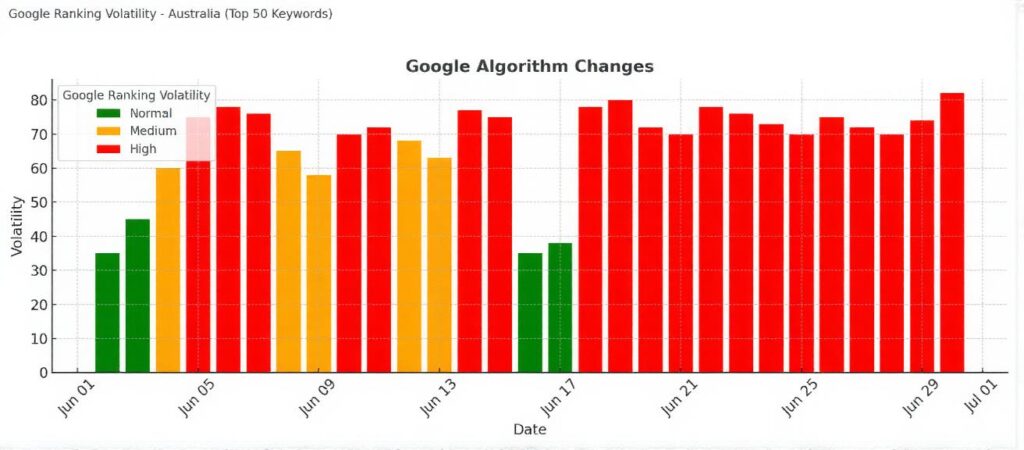
CognitiveSEO: (For Australia) 

  • What you see: In June 2025, the volatility score for Australia’s top 50 keywords spiked to 75 (high) on June 18, with red bars dominating the month. 
google ranking volatility
  • What it means: The Google June 2025 core update drove massive ranking changes in Australia. Daily monitoring helps you respond quickly to drops or gains. 

Sistrix: 

  • What you see: Volatility remained low to moderate from April through June, with a sharp spike in July, highlighting sudden mobile SERP instability after the update. 
  • What it means: Google updates can impact mobile SERPs later or more intensely. Prioritize mobile-first monitoring to catch new threats or opportunities. 
google update radar history

Across all tools, the Google update 2025 brought intense, industry-wide ranking volatility. 

The Core Update has notably impacted the Australian digital landscape, with significant ranking fluctuations observed across various industries.  

For Australian businesses and content creators, this update underscores the necessity of maintaining high-quality, user-centric content and ensuring technical SEO best practices are in place. 

Preparing for the Future of Search Algorithms 

With the google update rollout taking three weeks, it’s natural for the dust to take time to settle. 

If you’re waiting for things to “settle down,” stop. The google update 2025 didn’t just move the goalposts, it rebuilt the entire field. Every brand is now playing on a new pitch, and yesterday’s quick fixes just don’t cut it. 

Google’s search algorithms are more sophisticated than ever, rewarding those who prioritize genuine value over SEO theatre. This isn’t the time for shortcuts or complacency. It’s about meeting your audience where they are—and giving them what they actually need. 

Want’s Next?  

Build a SEO checklist for google core updates that you review quarterly, not just in a panic. Stay on top of your technical performance, keep your content honest and original, and be the site that Google’s future updates reward, not punish. 

The truth is there’s no finish line. Future google updates will keep coming, and only the businesses that embrace continuous improvement will thrive. Monitor, audit, adapt, and lead with trust. 

In 2025, there’s only one rule that matters: put people first, keep innovating, and never stop evolving with every google core algorithm update. 

Read More

Enter your details